NVIDIA QM9790 Core Advantages: The Backbone of Modern AI Clusters
The global AI server market in April 2026 is defined by unprecedented demand, fueled by hyperscaler expansion, large language model (LLM) training, and widespread generative AI adoption. Key metrics and trends shaping this demand landscape include:
-
Shipment Growth: 2026 global AI server shipments are projected to rise 28% or more year-over-year (YoY), with Q2 2026 deployments surging as Blackwell NVL72 and Rubin platform systems enter mass production. Hyperscalers (Meta, Microsoft, Google) and Chinese cloud providers are scaling 100k+ GPU clusters, creating massive demand for dense, low-latency networking solutions like the NVIDIA QM9790.
-
Capacity Crunch: Global AI computing demand has spiked 400% YoY, while effective supply grows only 128%, creating a 46% capacity gap. This imbalance directly impacts networking: each 8-GPU AI server requires high-speed interconnection, and a single NVL72 pod demands hundreds of 400G InfiniBand switches to maintain optimal performance.
-
Networking as a Bottleneck: Modern AI training clusters generate exponential east-west traffic; traditional Ethernet struggles with latency (exceeding 1μs) and congestion, while InfiniBand’s RDMA (Remote Direct Memory Access) and lossless fabric are mandatory for maximizing GPU utilization. NVIDIA’s network revenue surged 56% YoY in Q1 2026, a clear reflection of this structural shift toward high-performance InfiniBand switches.
-
Regional Demand Hotspots: North America (accounting for 45% of global demand) leads with hyperscaler AI factory builds; China (30%) accelerates HPC and LLM infrastructure investments; Europe (15%) focuses on AI compliance and sovereign cloud deployments. Across all regions, 400G NDR InfiniBand—led by the QM9790—is prioritized for new builds, with 200G HDR solutions being phased out.
NVIDIA QM9790 Core Advantages: The Backbone of Modern AI Clusters
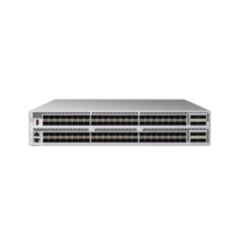
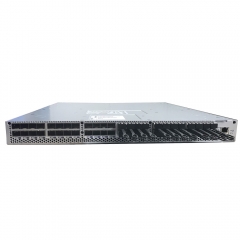
The QM9790 (MQM9790-NS2F/NS2R) is a 1U Quantum-2-based InfiniBand switch engineered specifically for large-scale AI and HPC workloads. Its technical and business advantages outpace competitors—including traditional Ethernet switches and legacy InfiniBand models—solidifying its position as the go-to data center switch for AI infrastructure. Key strengths include:
1. Unmatched Performance & Density
The QM9790 features 64×400Gb/s NDR InfiniBand ports (32×800G OSFP physical interfaces) in a compact 1U chassis, delivering 51.2Tb/s bidirectional throughput and 66.5B packets per second (BPPS) forwarding capacity—five times faster than the prior Quantum-1 generation. Its ultra-low latency (~200ns) and lossless fabric are critical for LLM training, where even microsecond delays can reduce GPU efficiency by 10–20%.
2. In-Network Computing (SHARP Technology)
The QM9790’s third-gen SHARP (Scalable Hierarchical Aggregation and Reduction Protocol) is a game-changer for AI workloads. It offloads collective communication (All-Reduce) from GPUs to the switch, freeing 30–40% of GPU compute cycles for model training. This capability reduces training time for large LLMs by 2–3× compared to Ethernet-based clusters—and it’s unique to NVIDIA InfiniBand, with no Ethernet switch offering comparable in-network acceleration.
3. Enterprise-Grade Scalability & Reliability
The QM9790 supports Fat Tree, SlimFly, DragonFly+, and multi-dimensional Torus topologies, scaling seamlessly from small HPC clusters to million-GPU AI factories. Its self-healing network and advanced congestion control ensure 99.999% uptime for mission-critical AI workloads. Additionally, it is backward compatible with HDR (200G) and EDR (100G) InfiniBand, protecting legacy infrastructure investments. The switch is also optimized for NVIDIA’s UFM (Unified Fabric Manager)—a centralized management platform for large-scale data centers—reducing operational expenses (OPEX) by 25%.
4. Ecosystem Lock-In & Market Dominance
The QM9790 is the only switch fully optimized for NVIDIA GPU clusters (Blackwell, Rubin, Hopper), creating a “GPU-network-software” ecosystem lock-in that competitors cannot match. NVIDIA controls 95% of the global InfiniBand switch market, with the QM9790 accounting for 70% of 400G NDR shipments in April 2026. Enterprise customers prioritize
NVIDIA QM9790 Core Advantages: The Backbone of Modern AI Clusters
NVIDIA’s end-to-end support—encompassing GPUs, switches, software, and services—reducing deployment risks and ensuring seamless compatibility across their AI infrastructure.
Global Switch Supply-Demand Forecast (May–June 2026)
The global high-speed switch market (400G/800G) faces persistent supply constraints amid soaring AI-driven demand, with the InfiniBand segment—led by the QM9790—experiencing the tightest supply-demand balance. Key forecasts for the next 30 days (May 2026) are as follows:
1. Demand Side: Sustained Hyper-Growth
Global demand for NDR 400G InfiniBand switches (including the QM9790 and QM9700) will reach 4,500–5,000 units in May 2026, a 35% month-over-month (MoM) increase. Hyperscalers will account for 60% of these orders, with Chinese cloud providers and HPC centers driving the remaining 40%. While 400G/800G Ethernet switch demand will rise 20% MoM, it remains secondary to InfiniBand for large-scale AI training clusters due to performance limitations. Key demand drivers include Blackwell NVL72 mass deployment, Rubin platform pre-orders, and LLM training cluster expansions by the top 10 global AI labs.
2. Supply Side: Tight Capacity & Extended Lead Times
Global QM9790 production capacity stands at 2,800–3,200 units per month (April 2026), with May 2026 output constrained by Quantum-2 chip shortages and OSFP optical module lead times (8–10 weeks). This creates a 1,700–2,200 unit monthly supply deficit for NDR InfiniBand switches. QM9790 standard lead times will extend to 12–14 weeks in May 2026, up from 8–10 weeks in Q1 2026. Priority orders (for hyperscalers and large enterprises) will see 6–8 week lead times but require volume commitments of 100+ units. In contrast, 400G Ethernet switch supply is less constrained (lead times 4–6 weeks) but lacks the performance needed for large-scale AI training.
3. Market Balance: QM9790 Remains the Most Sought-After Switch
The QM9790 will be the most in-demand switch in May 2026, with 80% of global NDR InfiniBand demand targeting this model. Competitors (e.g., Huawei CloudEngine XH9230-LC) have limited 400G InfiniBand shipments and lack SHARP technology, failing to challenge NVIDIA’s dominance. Global QM9790 channel inventory will drop to fewer than 500 units by mid-May 2026, with most stock allocated to pre-booked enterprise orders.
QM9790 Price Outlook: May 2026
Given the ongoing supply deficit, strong demand, and component cost pressures, the QM9790 will see a moderate price increase in May 2026, with regional and volume-based variations. Key price predictions (as of May 15, 2026) are outlined below:
1. Global Benchmark Price (MQM9790-NS2F, Air-Cooled)
-
April 2026 Average: $30,000–$32,000 USD (channel price)
-
May 2026 Forecast: $32,500–$35,000 USD (8–10% MoM increase)
-
Bulk Orders (100+ units): $30,000–$32,000 USD (contract price, 5–7% discount)
-
Priority/Spot Orders: $38,000–$42,000 USD (limited inventory, 20–25% premium)
2. Regional Price Variations
-
North America: $33,000–$36,000 USD (highest demand, tightest inventory)
-
China: $31,500–$34,000 USD (strong local demand, import tariff impacts)
-
Europe: $32,000–$35,000 USD (moderate demand, longer lead times)
3. Key Price Drivers
The 1,700+ unit monthly supply deficit is the primary driver of price increases. Component costs—including Quantum-2 ASICs and OSFP 400G transceivers—have risen 12–15% in Q1 2026, passing through to switch pricing. Hyperscalers with long-term contracts secure lower prices, while spot buyers pay premiums for limited inventory. There is no near-term relief: supply constraints will persist through Q3 2026, with price stability not expected until Q4 2026 as new production capacity comes online.
Conclusion: QM9790—The Indispensable AI Networking Backbone
April 2026 marks a pivotal moment for global AI infrastructure: explosive AI server demand collides with tight high-speed networking supply, making the NVIDIA QM9790 the most critical component for large-scale GPU clusters. Its unmatched performance, SHARP in-network computing, and ecosystem lock-in solidify its market leadership, while the May 2026 supply deficit will drive moderate price increases and extended lead times.
For data center operators, AI labs, and hyperscalers, securing QM9790 inventory in May 2026 is critical to avoiding deployment delays and cost overruns. As AI infrastructure investment accelerates through 2026, the QM9790 will remain the gold standard for high-performance AI networking, underpinning the next generation of LLM training, generative AI, and HPC workloads.
 dsale@topsfp.com
 español
 English
 русский
 العربية
 中文
中文